The basecamp strategy: the best day trips from Avignon

There is a mistake I see visitors make again and again. They book one night in Avignon, one in Saint-Rémy, one near Gordes, one in Arles, and they spend their whole holiday packing suitcases, checking in, checking out, and hunting for the next set of keys. They see a lot of hotel lobbies and not much of Provence.
Here is the better way: pick one base and stay put. And there is no better base than Avignon.
The honest truth is that there is so much to do within ninety minutes of the city that it is genuinely hard to make a simple recommendation. Roman aqueducts, the most famous vineyards in the Rhône, a “real” mountain, medieval hill villages, olive mills, abbeys, and even the beach are all within an easy drive. Unpack once, get to know your local café, and let the region come to you. If you are still working out how many nights to book, my guide to how long to spend in Avignon makes the case for four or five.
First, the transport reality
Let me be blunt, because most travel guides are not. With two exceptions, you need a car.
The two exceptions are Nîmes and Arles, both of which are a quick and frequent train ride from Avignon Centre, the station just outside the city walls. Arles is barely fifteen to twenty minutes away by regional train; Nîmes is around thirty. For everywhere else - the villages, the vineyards, the mountain, the abbey - public transport is either non-existent or so slow that it eats your whole day. Hire a car.
The one beautiful exception to the car rule is cycling. If you are the outdoor type and have time on your hands, this region is a paradise on two wheels. A dense network of cycle tracks and quiet secondary roads gives you an ideal, and far safer, playground than the main routes. Plenty of people come to this corner of Provence purely to ride.
For Roman history lovers: Pont du Gard, Nîmes and Arles
The single most spectacular sight near Avignon is the Pont du Gard, the towering three-tiered Roman aqueduct about forty minutes west. Everyone comes for the bridge, and rightly so. But do not make the rookie error of photographing it and leaving. The site includes the Mémoires de Garrigue, a landscaped walk through fifteen hectares of restored Mediterranean scrubland - olive groves, dry-stone walls, holm oaks - and it is well worth the time. It is the landscape that gives the monument its context.
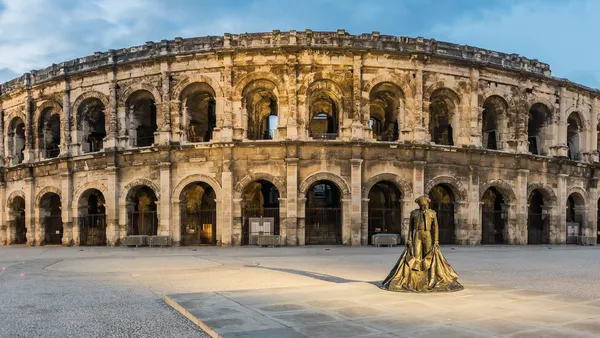
For a proper dose of Roman and historic France, Nîmes and Arles are both superb, and both are reachable by train. My one piece of advice: plan a long day for each. These are not quick stops. Nîmes has an amphitheatre so well preserved it still hosts events, plus the Maison Carrée temple. Arles has its own arena, the Roman theatre, the cloisters, and of course the ghost of Van Gogh on every corner. Either one will happily fill a full day, so do not try to combine them.
But the real treasure sits just on its doorstep: the Roman ruins of Glanum. Do not miss this one. It is a genuinely fantastic site - an entire Gallo-Roman town excavated at the foot of the Alpilles, with paved streets, the foundations of temples and baths, and a monumental arch and mausoleum that have stood by the roadside for two thousand years. Wandering through it with the white hills rising behind you is one of the most evocative experiences in the whole region, and it is right across the road from the cloister where Van Gogh stayed - you can easily pair the two in a single visit.
For wine lovers: Châteauneuf-du-Pape
Twenty minutes north of the city lies the most famous name in the southern Rhône: Châteauneuf-du-Pape. The village itself is small, crowned by the ruins of the popes’ summer castle, but the reason to come is the wine. The domaines here range from grand estates to tiny family cellars, and most welcome visitors for tastings. Go gently, spit if you are driving, and let yourself be talked into the bottle you did not plan to buy.
For the outdoor type: Mont Ventoux and the Dentelles
If you want a “real” mountain rather than a pretty hill, Mont Ventoux delivers. The bald white summit, famous to anyone who follows the Tour de France, dominates the horizon for miles. Cyclists treat the climb as a pilgrimage. But my favourite way to experience the Ventoux is not to go up it at all - it is to drive around its foothills, looping through the smaller, lesser-known villages that ring the base. They are quieter, they are lovely, and they offer the finest views of the mountain itself.
For climbers and serious walkers, the Dentelles de Montmirail are a jagged little range of limestone teeth that look far bigger than they are. Stunning hiking and scrambling - but a warning: in summer, access to the massif can be closed entirely under prefectural fire-risk rules. The same applies to Mont Ventoux and the Luberon. Always check the daily fire-risk bulletin before you set off in July and August, or you may drive an hour to find the trail barricaded.
If you are after something more secret, the Gorges du Toulourenc are fantastic - a river walk through a cool, narrow canyon that is a blessing in the heat. They are worth the detour, but be warned they are not easily accessible, so go prepared.
The Alpilles: Saint-Rémy, Les Baux and Maussane
The Alpilles are, for me, an absolute must. This little chain of white limestone hills holds three places worth your day.
Saint-Rémy-de-Provence is the elegant one - markets, plane-tree squares, the asylum where Van Gogh painted, and the Roman ruins of Glanum on its doorstep. Les Baux-de-Provence is the dramatic one, a fortified village clinging to a rocky spur with a ruined château and views for miles. And tucked between them is Maussane-les-Alpilles, the one most visitors miss.
Whichever you choose, do one thing: visit a working olive oil mill. The Vallée des Baux is one of France’s great AOC olive oil regions, and a tour and tasting at one of the historic moulins around Maussane and Les Baux is a genuine highlight - the kind of authentic experience that stays with you long after the postcards fade.
My personal favourite: Sénanque Abbey
If you let me send you to just one place on this list, it would be the Abbaye Notre-Dame de Sénanque, hidden in a fold of the hills near Gordes. It is a working Cistercian monastery, and its twelfth-century architecture is some of the purest and most beautiful in France - all clean stone, perfect proportions, and silence.
It is quiet, tranquil, and deeply spiritual regardless of your faith or lack of one. Most people know it from the photographs of the lavender fields in front of the church, which bloom from roughly mid-June to mid-July. Come for the lavender if you must, but stay for the building. One note: the lavender fields are fenced off and you are not allowed to walk into them, so admire from the path.
A day at the beach
People forget that the Mediterranean is within reach. A beach day makes a lovely change of pace, and you have options depending on your taste, from family-friendly resort sand to wild, empty dunes. The most striking is La Plage de l’Espiguette, near Le Grau-du-Roi, a vast expanse of rolling dunes that happens to be home to one of the largest clothing-optional beaches in continental Europe. It is around an hour and a quarter away, so make a full day of it.
A word on the Luberon’s famous villages
You will have seen the photographs: Gordes tumbling down its hillside, the red ochre cliffs of Roussillon, the brooding ruins above Lacoste. They are genuinely beautiful, and I am not going to tell you to skip them.
But I will be honest. In high summer they are very difficult. Gordes in particular becomes a slow crawl of traffic and a desperate hunt for a parking space, and Roussillon and Lacoste are not far behind. If you are patient, set off early, and do not mind the hassle, they are well worth the visit. If the idea of queuing for a parking spot in thirty-five-degree heat fills you with dread, save them for the shoulder season. Fontaine-de-Vaucluse, with its astonishing spring, is also nearby and very nice, though be ready for a fair bit of walking to reach the source.
The golden rule
One piece of advice applies to every single trip on this list: take your time. This is especially true in summer, when the heat is fierce and the afternoons are for shade, not sightseeing. The whole point of the basecamp strategy is that you do not have to rush. Drive out in the cool of the morning, find a long lunch, come home in the evening. Avignon will be waiting.
The day trips at a glance
| Destination | Driving time | Best for | Notes |
|---|---|---|---|
| Châteauneuf-du-Pape | ~20 min | Wine lovers | Tastings; spit if driving |
| Saint-Rémy-de-Provence | ~30 min | Markets, Van Gogh, Glanum | Part of the Alpilles |
| Arles | Train ~20 min | Roman history, Van Gogh | Plan a long day |
| Les Baux / Maussane | ~40-45 min | Hilltop village, olive oil | Visit a working mill |
| Pont du Gard | ~40 min | Roman engineering | Walk the Mémoires de Garrigue |
| Nîmes | Train ~30 min | Roman monuments | Plan a long day |
| Mont Ventoux (Bédoin) | ~45-50 min | Cycling, big views | Drive the foothill villages |
| Sénanque Abbey | ~50 min | Architecture, quiet | Lavender mid-June to mid-July |
| Dentelles de Montmirail | ~45 min | Hiking, climbing | Summer fire closures possible |
| Gordes / Roussillon / Lacoste | ~45-55 min | Postcard villages | Avoid midsummer if you can |
| Gorges du Toulourenc | ~1 hr 10 | River walk, escaping heat | Hard to reach; go prepared |
| Plage de l’Espiguette | ~1 hr 15 | A day at the beach | Vast dunes; naturist section |
Avignon is not a place to pass through. It is a place to settle into, and then explore from. Book the extra nights, get the car, and let Provence unfold around you one easy day at a time.