Roman Provence from Avignon: a local's guide to the ancient south

The name gives it away. “Provence” comes from Provincia - because this was the first Roman province beyond Italy itself, the Romans’ beloved Provincia Nostra, “our province.” Two thousand years later, the evidence is still standing, and some of it is standing better than almost anything in Rome. If you have the faintest interest in the ancient world, this is one of the great concentrations of Roman heritage in Europe - and Avignon sits right in the middle of it.
Here is the honest local’s guide to the Roman south: what to see, what you can reach by train, what genuinely needs a car, and the one site that most visitors overlook but that I would send you to first.
Why Avignon is the perfect base for Roman Provence
The Roman sites here are spread across a wide arc, and no single town holds all of them. That is exactly why you want a base rather than a string of one-night hotels - and Avignon, sitting at the centre of the arc with a proper rail hub, is the natural choice. Two of the very best Roman towns, Arles and Nîmes, are a short, cheap train ride away with no car at all (see our full guide to Provence without a car). The rest - Orange, the Pont du Gard, Glanum - round out an itinerary you can spread over several relaxed day trips. For the wider strategy, our piece on the best day trips from Avignon lays out the basecamp logic.
Arles: theatre, arena, and a whiff of Rome
Arles is my top recommendation to start, and not only for the Romans - it is simply one of the most charming towns in the south, and the train from Avignon Centre drops you a short, flat walk from the old centre. But the Roman layer here is exceptional.
Two monuments carry it. The Théâtre antique is the Roman theatre, still used for performances, its two lonely surviving columns a quietly moving sight. A short walk away, the Arènes d’Arles is the amphitheatre - the arena - and it is the showpiece: a two-tiered ring of stone that still fills with crowds for events today. Standing inside, you get a genuine, human-scale sense of what the Romans built for spectacle. It is a lovely comparison point to the Colosseum in Rome - far smaller, of course, but far more intimate, and you are not fighting the same crowds.
One honest note for the history buffs: Arles also had a Roman circus for chariot races, but there is very little to see today - essentially foundations beside the archaeology museum. Its great centrepiece, an Egyptian obelisk, was hauled into town centuries ago and now stands in the Place de la République. So come for the theatre and the arena; treat the circus as a footnote.
We are publishing a dedicated Arles guide shortly, because the town deserves far more than a Roman paragraph.
Don’t skip the Musée départemental Arles antique
If the ruins whet your appetite, the Musée départemental Arles antique (the striking blue building locals just call the Musée de l’Arles antique) is one of the best archaeological museums in France. The star exhibits: a hall of extraordinary Roman mosaics, a marble bust widely believed to depict Julius Caesar, recovered from the bed of the Rhône in 2007, and the Arles-Rhône 3 - an astonishing 31-metre Roman trading barge raised intact from the river. It is a short walk or shuttle from the centre and it deepens everything else you will see that day.
Nîmes: the best-preserved Roman city in France
Nîmes is the other easy win by train, and it is breathtaking. Technically it sits just over the regional border in Occitanie rather than Provence proper, but historically and culturally it is pure Roman south, and no round-up would be honest without it.
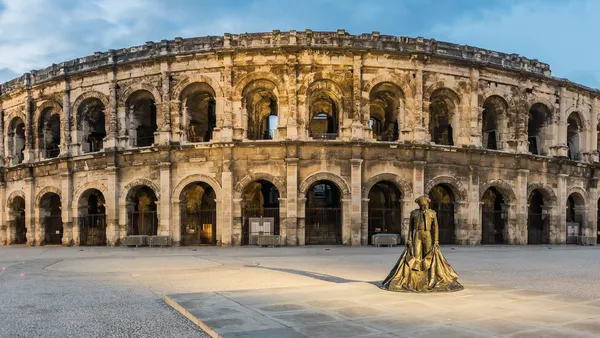
Two monuments here are world-class. The Maison Carrée is one of the best-preserved Roman temples anywhere on earth - a near-complete classical temple, columns and all, sitting calmly in the middle of a modern square as though it simply refused to fall. And Les Arènes de Nîmes is one of the best-preserved Roman amphitheatres in existence, better preserved than the arena at Arles, still hosting concerts and events under the same arches that held twenty thousand Romans. Seen together in a single day, the two are quietly staggering.
Orange: the greatest Roman stage wall in the world
A short hop north of Avignon, Orange holds the Théâtre antique d’Orange, and it has something almost nowhere else can claim: its monumental stage wall, the scaenae frons, still stands nearly intact - a sheer cliff of Roman stone that Louis XIV reportedly called the finest wall in his kingdom. It is a UNESCO World Heritage site, and the sense of scale when you stand on the stage floor and look up is hard to forget. Pair it with the Roman triumphal arch on the edge of town.
Glanum: my favourite, and the one that needs a car
Now for the site I would send you to first if you had the means to reach it - because Glanum, just outside Saint-Rémy-de-Provence, quietly outdoes them all for atmosphere.
Here is the honest catch: you will need a car. There is no easy car-free route, and that is precisely why it stays so uncrowded. But the reward is real. The scale of Glanum is genuinely surprising - a whole excavated town, not a single monument, with streets, temples, baths and houses laid bare. The condition of the remains is remarkable, and the setting, tucked against the rugged Alpilles hills, gives it a tranquility the busier sites simply cannot match. Come early in the morning, catch the low light on the stone, add a little imagination, and you can genuinely picture yourself two thousand years ago, standing in a living Roman town.
Right by the entrance stand “Les Antiques” - two extraordinarily well-preserved monuments that you can see for free without even entering the site: the Mausoleum of the Julii (around 30 BC) and a triumphal arch (around 10-20 AD). They are among the finest Roman remains of their kind anywhere, and they sit quietly by the roadside as though it were the most normal thing in the world.
Pont du Gard: the aqueduct that stops you in your tracks
The Pont du Gard is the other unmissable, and the other one that really wants a car to reach comfortably. It is worth every effort. This Roman aqueduct bridge, built around 50 AD, is the tallest the Romans ever raised - three tiers of golden stone arches leaping across the Gardon river, once part of a fifty-kilometre channel carrying water to Nîmes. Its scale is staggering and its condition outstanding, which is exactly why it has been a UNESCO World Heritage site since 1985. Go, stand beneath it, and try to comprehend that it was built without mortar, by hand, twenty centuries ago.
A Roman footnote for the curious: the Via Domitia
If you want to feel the deeper Roman roots, look up the Via Domitia - the oldest Roman road in Gaul, laid out around 118 BC to link Italy with Spain, threading straight through this region. The most famous exposed section of the road itself is actually in Narbonne, to the west, not in Provence. But Provence holds a beautiful piece of the story: the Pont Julien, near Apt in the Luberon, an intact Roman bridge two thousand years old that once carried the Via Domitia over the river. It is a quiet, free, deeply atmospheric stop for anyone who likes their history off the beaten track - and, yes, another one that needs a car.
How to plan it: a car-free core and a driving day
Here is the honest way to structure Roman Provence from Avignon:
Without a car, you can still see a great deal. Give Arles a full day (theatre, arena, the Musée de l’Arles antique) and Nîmes another (Maison Carrée and the arena), both by train from Avignon Centre. Add Orange as a short third trip. That alone is a superb Roman itinerary.
With a car for a day or two, add the sites that reward the effort: Glanum for atmosphere, the Pont du Gard for sheer scale, and the Pont Julien if you are a true enthusiast. If you only rent wheels for a single day, I would spend it on Glanum and the Pont du Gard together - they are reasonably close, and between them they are the most magical Roman experiences in the region.
The bottom line
Provence earned its name from Rome, and it has never quite let go of it. Base yourself in Avignon, ride the train to Arles and Nîmes, and rent a car for one well-chosen day to reach Glanum and the Pont du Gard, and you will have seen Roman remains that rival - and in preservation sometimes beat - anything in Italy. Come early, bring your imagination, and let the old province do the rest.
Planning a Roman-themed trip and want a local’s honest steer on which sites are worth your limited time? We are always happy to help with free, practical advice - just get in touch.